


Page 1
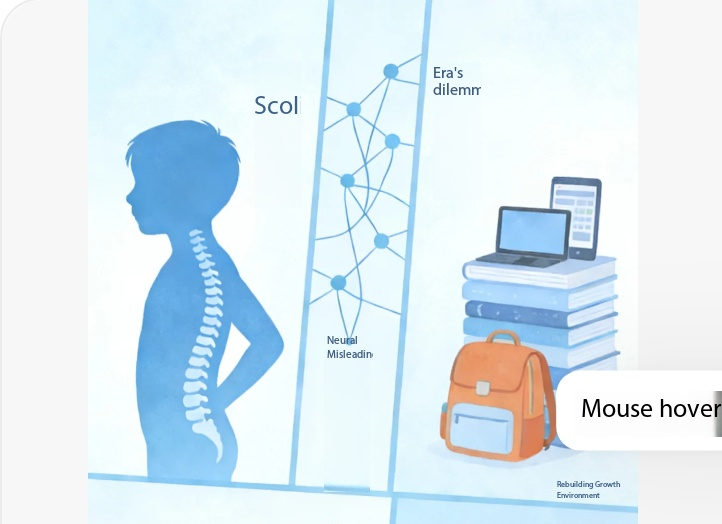
Rebuilding Growth Environment
Brain Re-education
Page 2
What is happening in the brain when a child’s spine begins to curve?
Full article 4185 words | Reading time: 9 minutes
Page 3
After understanding the “neuro-muscular interaction shaping theory,” which explains how experience solidifies neural pathways, neural commands shape fascial structures, fascia stiffens and locks neural choices, and cycles strengthen “neuro-fascial interaction shaping,” let’s look at the currently common pediatric scoliosis.
Initial Stage: The brain is receiving and “justifying” an incorrect belief
Initially, it may be due to poor posture habits (such as long-term slanted writing)
Page 4
Work, heavy backpacking on one shoulder, imbalanced growth and development (muscle fascia and bone velocity don’t match when puberty growth surges), Slight external forces (such as protective posture after sports injury), or even genetic copies of the parent’s epidural stress morphology during growth and development, constantly affect the child’s spinal area to begin to be under unbalanced stress. At this time:
1. Abnormal sensory input: The proprioceptors in the muscles, joints, and surrounding tissues on both sides of the spine send asymmetric signals to the brain.
2. Preliminary interpretation and adaptation of the brain: The brain tends to adjust its instructions to adapt to the emerging “status quo,” unconsciously tightening certain muscle groups slightly to find a temporary pattern of balance. This is where the “empirical neural pathways” start: a compensatory set of motion instructions is used repeatedly as a new “common procedure,” and the relevant neural pathway is reinforced.
Structural Shaping Phase: The brain’s instructions become “the carving knife for fascia.”
Page 5
Over time, this solidified abnormal movement pattern begins to produce structural consequences:
The continuous uneven neural instructions from the brain cause the muscles on both sides of the spine to contract unevenly for a long time, which directly affects the fascia network. The fascia will be reshaped in response to continued mechanical stimulation and become dehydrated, adhesive, and deformed in high pressure areas. The “neural instructions shape the fascia structure” is reflected here: abnormal electrical signals, through the tension of the muscle, are “written” into the physical structure of the fascia.
Formation of a vicious cycle: The brain “kidnapped”
When fascia begins to stiffen, the true vicious cycle lock forms:
Page 6
1. Twisted “intelligence”: The rigid fascia itself becomes a twisted signal transmitter that continually sends abnormal, restricted sensory information to the brain. The brain receives a “map of the body.” ” It has been tampered with. This is “muscular rigidity relock neural selection”: a rigid structure that in turn limits the range of motor patterns that the brain can choose and feel “right.”
2. Circular reinforcement and normalization: The brain continues to send commands to maintain abnormal states based on incorrect “body maps,” further reinforcing fascial imbalance. Ultimately, the scoliosis posture is initially fully “learned” and normalized as an unconscious movement pattern.
Why is this cycle more likely to trigger in today’s society? — A comparison with the growth patterns of post-70s and post-80s generations
After understanding this theory, an important question arises: why did similar issues seem less common in previous generations’ growth? Comparison with
Page 7
Below, the growth patterns of those born in the 1970s and 1980s have unintentionally built a “systematic protection” against this cycle:
1. Activity Mode: Dynamic Diversity vs. Static Monotony
*Past: Large amounts of outdoor free play (running, jumping, climbing, scaling), household chores, and walking/cycling provided multidirectional, non-repetitive three-dimensional movement. This allowed the brain to learn rich, dynamic movement patterns and provided balanced fascial tension stimulation.
*Nowadays: Long periods of sitting and screen time at school, body remains static and forward-leaning for extended periods. The brain repeatedly strengthens the same neural pathways; fascia is compressed in one direction, lacking multi-angle stretching, making imbalance more likely.
2. Posture Environment: Natural Correction vs. Reinforcement of Bad Habits
*Past: Hard seats, backless benches, hard beds and other environments forced the body to frequently perform self-adjustments, naturally training core muscles and unconsciously correcting posture.
Page 8
*Nowadays: Soft sofas, ergonomic support, and overly comfortable furniture replace the body’s muscle support needs, causing the brain and muscles to “slacker,” resulting in deep stabilizing muscle groups failing to develop.
3. Perceptual Development: Integration is rich vs. Input is flat
*Past: In running and playing, proprioception (body position sense) and vestibular sense (balance sense) developed fully and naturally, establishing an accurate “body map”.
*Nowadays: Primarily static activities; insufficient key sensory stimulation can lead to inaccurate perception of body posture by the brain, making it difficult for individuals to consciously maintain proper posture.
The central difference is that the past lifestyle itself was a natural process that consistently interrupted poor solidification and promoted the balanced development of nerves and fascia. In diverse dynamic activity, the brain constantly resets any wrong cycle that might have begun. Contemporary children’s living environments are more likely to induce the brain to enter the negative channel of “single postural curing of fascia imbalance.”
Page 9
The Key Overlap Effect: When “Static Survival” Meets “Growth Surge”
What is even more concerning is that the above “static survival mode” forms a highly destructive “perfect storm” with the rapid growth and development period that contemporary children commonly experience. Using the metaphor of navigation, this is equivalent to:
1. Terrain changes (spikes in growth): height increases rapidly during adolescence, and the “physical territory” represented by navigation maps expands dramatically and reshapes the landscape in a short period of time. The brain is this “navigator.”” The old map was suddenly completely obsolete, and it needed a lot of new driving data to create a new map to take control of this new and unstable territory.
2. Navigation Stagnation (Static Survival): However, at this critical moment when exploration and map updating are most needed, children are fixed in their seats (static survival). This effectively stops the navigator from conducting any on-site reconnaissance—neither receiving new road feedback nor attempting to plan new routes.
Page 10
3. Catastrophic navigational error: Faced with unfamiliar new terrain and unable to explore it, the navigator (brain) has to adopt the most conservative strategy – clinging on to a known, known terrain. But it was originally a route that bypassed small roads or even the wrong paths (such as tables and crouching poses) and set it as the “only main road” through the new territory. Thus, both the “mapping” (creation of neural pathways) and the “road building” (growth of skeletal fascia) of the entire process of rapid growth are tightly surrounded by this faulty “main road.”” Unfold.
In contrast with the past: Post-70s and post-80s generations, during the “terrain transformation period” (rapid growth), navigators (brains) have been undergoing high-intensity, multi-route “field driving training” (diverse exercise), enabling them to quickly draw accurate, flexible new maps and control new territories.
Generational Dilemma: When “Mapmakers” Also Lose Their Way